
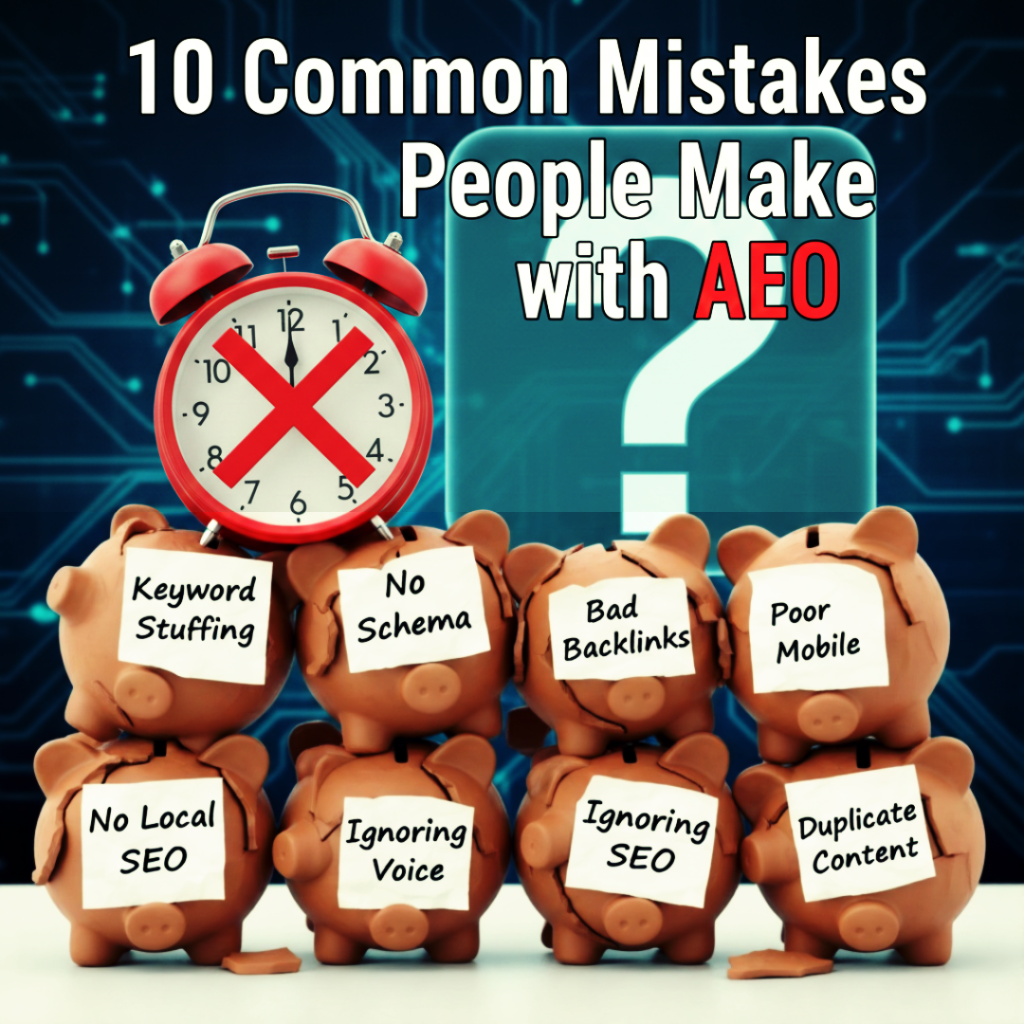
Answer Engine Optimization (AEO) is the next evolution of search visibility. Unlike traditional SEO—which focuses on ranking web pages for keywords—AEO is about positioning your content to be the direct answer that search engines, AI assistants, and voice devices deliver instantly. In a world where people ask Siri, Alexa, or Google Assistant for quick solutions, being the chosen answer is far more powerful than simply appearing on page one.
This shift from keyword stuffing to intent-driven optimization means businesses must rethink their approach. It’s no longer enough to chase rankings—you need to deliver answers that satisfy search intent in real time. Unfortunately, many companies still fall into outdated SEO habits. They overlook structured data, ignore voice search, or fail to track performance. These mistakes limit visibility, reduce credibility, and ultimately cost leads and revenue.
This guide breaks down the 10 most common mistakes businesses make with AEO(Answer Engine Optimization)—and how to avoid them so your brand can thrive in the era of AI-powered search.
💨Mistake 1: Ignoring Structured Data
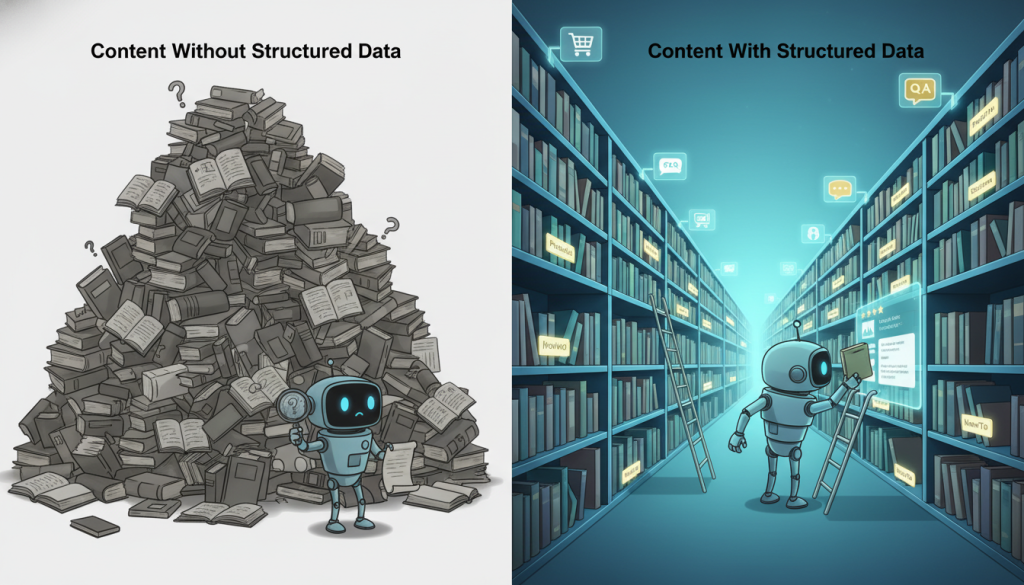
One of the biggest mistakes in AEO(Answer Engine Optimization) is overlooking structured data. Search engines aren’t just reading your words—they’re trying to understand the meaning behind them. Without schema markup, your content is just text. With it, your content becomes machine-readable answers that search engines can confidently display in rich results, voice responses, and AI-driven snippets.
Why Structured Data Matters
Search engines rely on structured data to:
- Interpret context: Schema clarifies whether your page is a product, service, FAQ, or local business.
- Deliver rich results: Featured snippets, knowledge panels, and voice answers often come from well-marked content.
- Enhance visibility: Schema improves your chances of appearing in “position zero.”
- Boost CTR: Rich snippets with ratings, FAQs, or maps attract more attention than plain text links.
Key Schema Types for AEO(Answer Engine Optimization)
- FAQ Schema → Enables direct Q&A display.
- HowTo Schema → Ideal for step-by-step instructions.
- LocalBusiness Schema → Essential for “near me” searches and Maps visibility.
- Product & Service Schema → Adds pricing, availability, and reviews.
The Risk of Ignoring It
Your content may:
- Fail to surface in rich results.
- Be overlooked by answer engines in favor of competitors.
- Miss high-intent traffic from voice and AI-driven queries.
Best Practice
Think of schema as the language search engines speak fluently. By embedding structured data, you give engines the confidence to feature your answers front and center.
💦Read More: Top AEO Ranking Factors You Must Know
💨Mistake 2: Providing Vague or Incomplete Answers
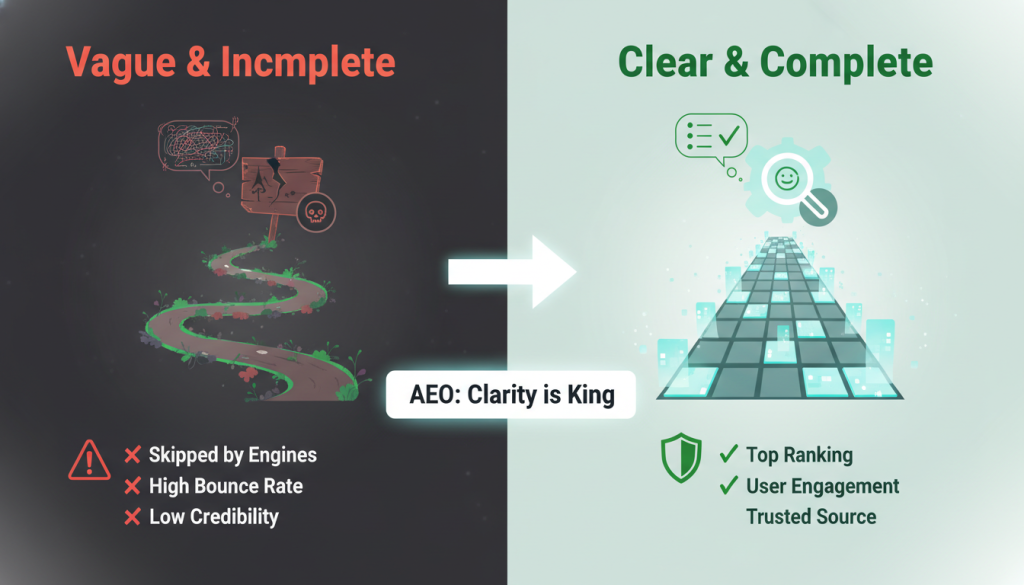
Clarity is king in AEO(Answer Engine Optimization). Search engines and AI assistants want to deliver the best answer. If your content is vague, incomplete, or buried in fluff, it won’t be chosen.
What Search Engines Like
- Complete answers in a single response.
- Concise, straightforward language.
- Direct addressing of the query.
- Supporting context (examples, steps, definitions).
- Snippet-ready formatting (lists, bullets).
The Risk of Vague Content
- Engines skip unclear answers.
- Users bounce quickly, signaling low relevance.
- Credibility decreases.
Best Practice
Write as if you’re answering a customer face-to-face. Deliver a direct, complete, context-rich response that solves the user’s intent immediately.
💨Mistake 3: Ignoring Mobile and Voice Search
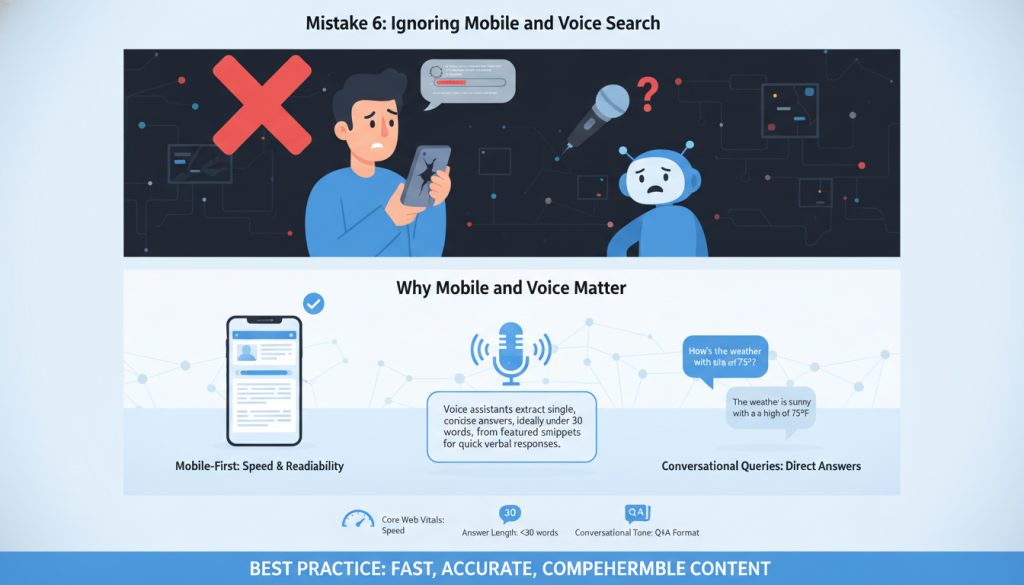
Ignoring mobile-first indexing and the rise of voice search means you are creating content for an outdated user. Voice queries are conversational, and mobile users demand speed. If your site is slow or your answers are not concise enough for a verbal response, answer engines will ignore you, costing you high-intent traffic.
Why Mobile and Voice Matter
- Mobile-First: Most users search on mobile; speed and readability are non-negotiable ranking factors.
- Voice Snippets: Voice assistants extract a single, concise answer (ideally under 30 words) from featured snippets.
- Conversational Queries: Voice searches are longer, natural-sounding questions that require direct, natural-sounding answers.
Key Optimization Areas for AEO(Answer Engine Optimization)
- Core Web Vitals: Ensure excellent mobile loading speed and visual stability.
- Answer Length: Write the key answer to be highly concise (under 30 words).
- Conversational Tone: Use question-based headings and natural, easy-to-understand language.
Best Practice
Design content to be consumed quickly and read aloud. Your answer must be fast, accurate, and immediately comprehensible.
💨Mistake 4: Keyword Stuffing Instead of Intent Matching
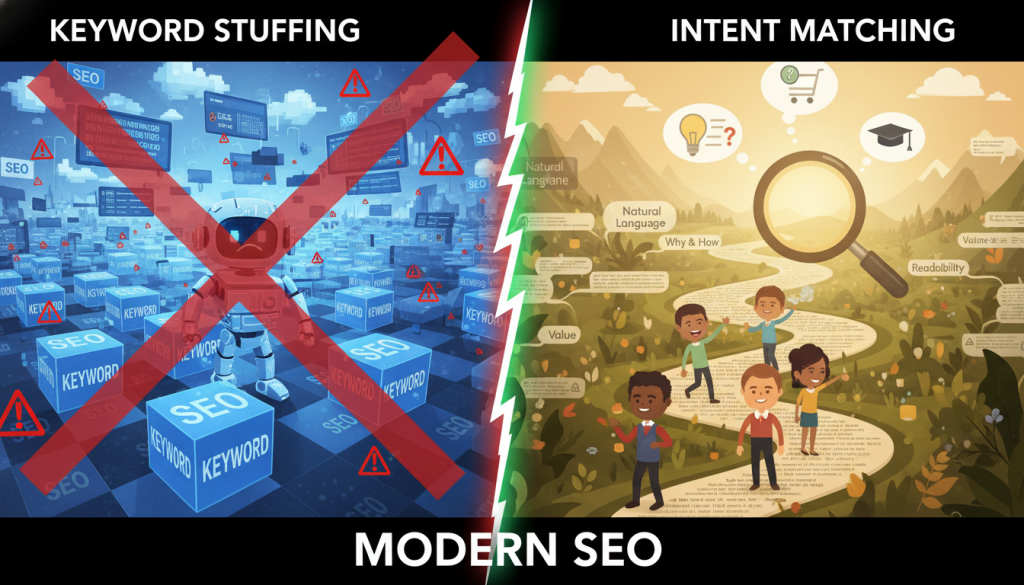
One of the fastest ways to lose credibility with both users and search engines is keyword stuffing. In the early days of SEO, repeating a keyword dozens of times might have improved rankings. Today, it’s a clear red flag. Search engines are far more advanced—they don’t just scan for keywords; they evaluate whether your content truly satisfies the user’s intent.
What Search Engines Like
Modern algorithms reward content that:
- Matches user intent → Engines want to know if your content solves the problem behind the query, not just repeats the words.
- Uses natural language → Keywords should fit organically, never feel forced or robotic.
- Explains the “why” and “how” → Context, reasoning, and actionable details signal depth.
- Delivers value beyond keywords → Examples, data, and insights build authority.
- Balances readability and optimization → Content must be easy for humans and machines to understand.
The Risk of Keyword Stuffing
- Appears spammy and harms user trust.
- Signals low-quality content, hurting rankings.
- Misses long-tail and intent-driven search opportunities.
Best Practice
Shift from keyword density to intent-driven optimization. Ask: What is the user really trying to achieve? Then write a clear, helpful, complete answer that solves that need. Use keywords strategically, but let clarity, context, and usefulness guide your content.
💨Mistake 5: Neglecting Local Optimization
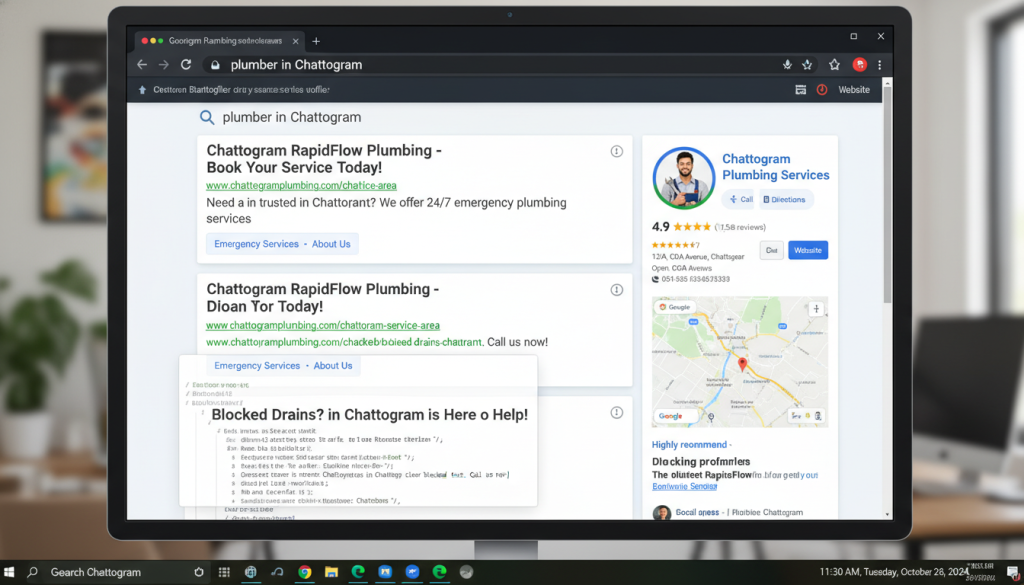
Local search is the lifeblood of service-based businesses. When users type or speak queries like “best dentist near me” or “plumber in Chattogram,” they’re signaling strong intent—they’re ready to take action. If your content isn’t optimized for local visibility, you’re leaving money on the table and giving leads to competitors.
What Search Engines Like
Search engines elevate content that demonstrates local relevance and authority:
- Geo-specific content → Pages tailored to specific cities, neighborhoods, or service areas.
- Google Business Profile optimization → Verified profiles with accurate details, hours, and reviews.
- Location-specific CTAs → “Book your Chattogram plumbing service today.”
- Embedded Google Maps → Builds credibility and helps users find you.
- LocalBusiness schema → Clarifies your business type, address, and service area.
- “Near me” optimization → Natural integration of proximity-based phrases for voice and mobile search.
The Risk of Ignoring Local Optimization
- Lost high-intent, ready-to-convert traffic.
- Competitors dominate “near me” and geo-specific results.
- Your business appears less trustworthy without verified profiles and schema.
Best Practice
Treat each service area as its own micro-market. Use location-specific pages, integrate your Google Business Profile, add LocalBusiness schema, embed maps, showcase reviews, and include geo-targeted CTAs. This strengthens both user experience and search engine trust.
By embracing local optimization, you capture the most valuable traffic—people ready to buy, book, or visit now.
💨Mistake 6: Weak Internal Linking
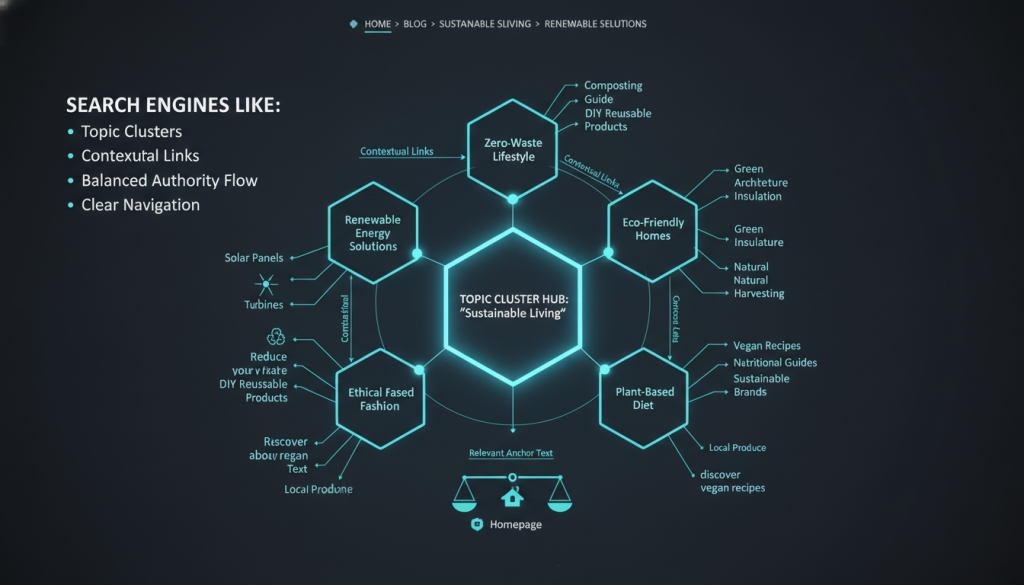
Internal linking is one of the most overlooked elements of AEO(Answer Engine Optimization). Many businesses focus on keywords and content creation but overlook the importance of site structure. Without strong internal linking, search engines struggle to understand how your content connects, which pages matter most, and where to assign authority.
What Search Engines Like
Engines reward websites with clear, organized internal architecture:
- Topic clusters → Grouping related content around a central hub boosts topical authority.
- Contextual links → Naturally placed links help users and crawlers navigate.
- Balanced authority flow → Power shouldn’t only flow to the homepage.
- Clear navigation → Breadcrumbs, menus, and structured linking improve crawlability.
- Relevant anchor text → Descriptive text helps engines understand the linked page’s purpose.
The Risk of Weak Internal Linking
- Important pages may be ignored or undervalued.
- Authority becomes scattered instead of concentrated.
- Users struggle to navigate, causing high bounce rates and lower engagement.
Best Practice
Think of internal linking as the circulatory system of your website. Every link should serve a purpose—either guiding the user or signaling relevance to search engines. Build topic clusters, add contextual links, and use descriptive anchors. This strengthens crawlability and boosts your site’s perceived expertise.
By fixing weak internal linking, you transform your website from a collection of isolated pages into a cohesive knowledge hub—exactly what answer engines prefer to showcase.
💦Read More: How to Get More Customers for Your Local Auto Repair Service
💨Mistake 7: Missing Schema for FAQs & How-To Content
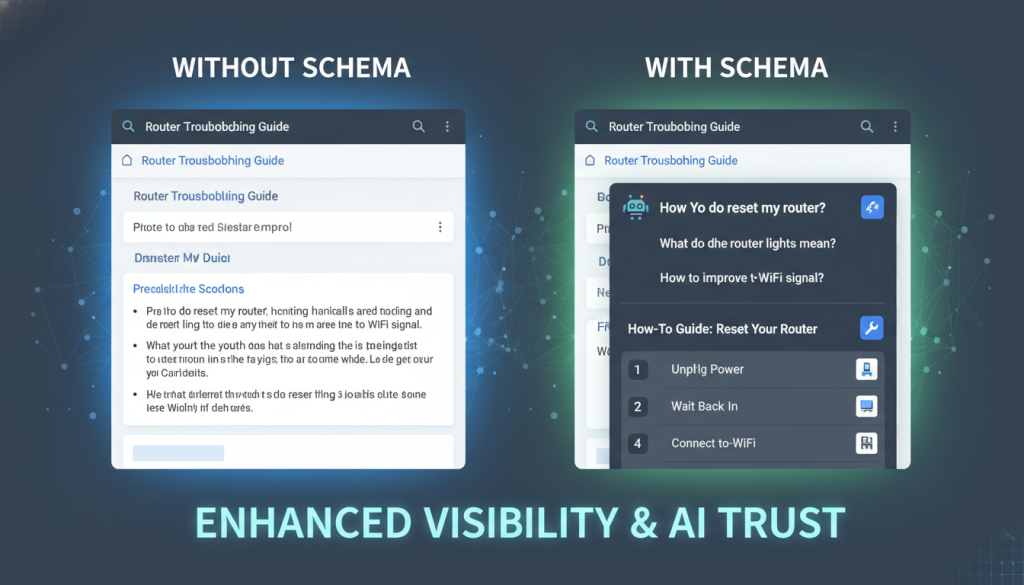
In Answer Engine Optimization (AEO), structured formats are a major advantage. Search engines prioritize content they can interpret easily, and schema markup for FAQs and How-To guides is one of the strongest tools for making your answers visible. Without it, even high-quality content may never surface.
What Search Engines Like
Search engines elevate content that is structured, organized, and easy to extract:
- FAQ Schema → Enables engines to pull direct Q&A pairs into search results and voice responses. Ideal for conversational queries like “How do I reset my router?”
- HowTo Schema → Perfect for step-by-step instructions. Engines can display each step visually or read them aloud via voice assistants.
- Clear formatting → Lists, numbered steps, and concise responses improve extractability.
- Context-rich answers → Schema adds metadata that clarifies meaning and intent, enhancing trust for AI-driven search.
- Enhanced visibility → Structured content is far more likely to be selected for featured snippets, knowledge panels, and voice answers.
The Risk of Missing Schema
- FAQs may never appear in rich results, even if they’re strong.
- How-to content is less likely to surface in voice search.
- Competitors using schema gain visibility while your content stays hidden.
Best Practice
Think of schema as the bridge between your content and search engines. Add FAQ schema to common questions and HowTo schema to instructional content. Keep answers concise, organized, and easy for machines to parse. This boosts visibility and positions your brand as a trusted source for clear, authoritative answers.
💨Mistake 8: Failing to Track Performance
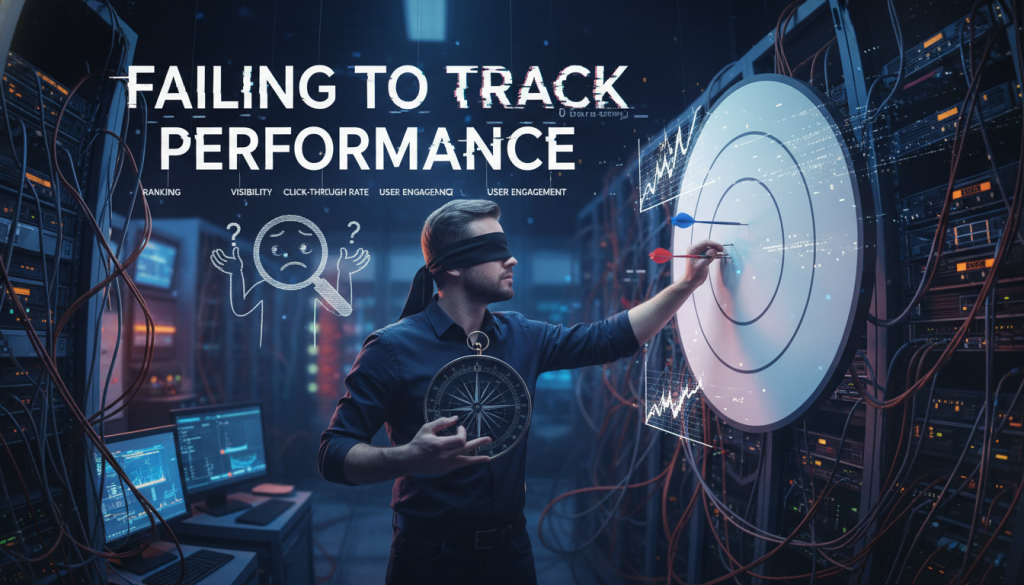
One of the most costly mistakes in AEO(Answer Engine Optimization) is operating without data. You can optimize for voice search, implement schema, and structure content perfectly—but without performance tracking, you don’t know what’s working or what needs improvement. Search engines reward websites that refine and evolve based on insights.
What Search Engines Like
Engines elevate sites that demonstrate ongoing optimization:
- Ranking visibility → Tracking keyword and answer rankings shows whether your content appears in featured snippets and voice results.
- Click-through rate (CTR) → High CTR signals that your answers are relevant and appealing.
- User engagement metrics → Bounce rate, time on page, and interaction levels confirm quality.
- Regular updates → Consistently refreshed content indicates reliability and authority.
The Risk of Ignoring Performance Tracking
- Missed opportunities to scale what’s working.
- Poor-performing pages remain unnoticed and drag down authority.
- Competitors who measure and refine their strategy will outperform you.
Best Practice
Treat analytics as the compass of your AEO(Answer Engine Optimization) strategy. Track rankings, CTR, engagement, and schema health. Conduct regular audits to update content and close performance gaps. Consistent tracking ensures your content stays aligned with algorithm changes—and ahead of competitors.
In AEO(Answer Engine Optimization), success isn’t just about publishing answers; it’s about measuring, learning, and improving.
💨Mistake 9: Relying Too Much on Automation Without Review

Automation is powerful, but in AEO(Answer Engine Optimization) it cannot replace human oversight. AI-generated content can scale production, but without editorial review it may introduce inaccuracies, inconsistencies, or misleading information. Search engines prioritize accuracy, credibility, and trust—qualities automation alone cannot guarantee.
What Search Engines Like
Search engines reward content that blends automation with human quality control:
- Accuracy and reliability → Engines favor content that is factually correct and dependable.
- Editorial oversight → Human review ensures alignment with brand voice, context, and user needs.
- Trust signals → Verified sources and authoritative tone strengthen credibility.
- Consistency across pages → Review prevents duplication, contradictions, and confusion.
- Balanced automation → Engines value efficiency, but not at the expense of quality.
The Risk of Over-Automation
- AI-generated errors or outdated information slip through.
- Credibility suffers if readers find inaccuracies.
- Engines may demote content that feels repetitive, spammy, or unreliable.
Best Practice
Use automation to scale—but complement it with expert review. Let AI handle drafting, templates, and repetitive tasks, while humans refine accuracy, tone, and nuance. This balance ensures efficiency without compromising trust, giving you the quality edge engines require when selecting the best answer.
By combining automation with editorial review, you create a scalable, credible, and high-performing AEO(Answer Engine Optimization) framework.
💨Mistake 10: Overlooking User Intent & Context
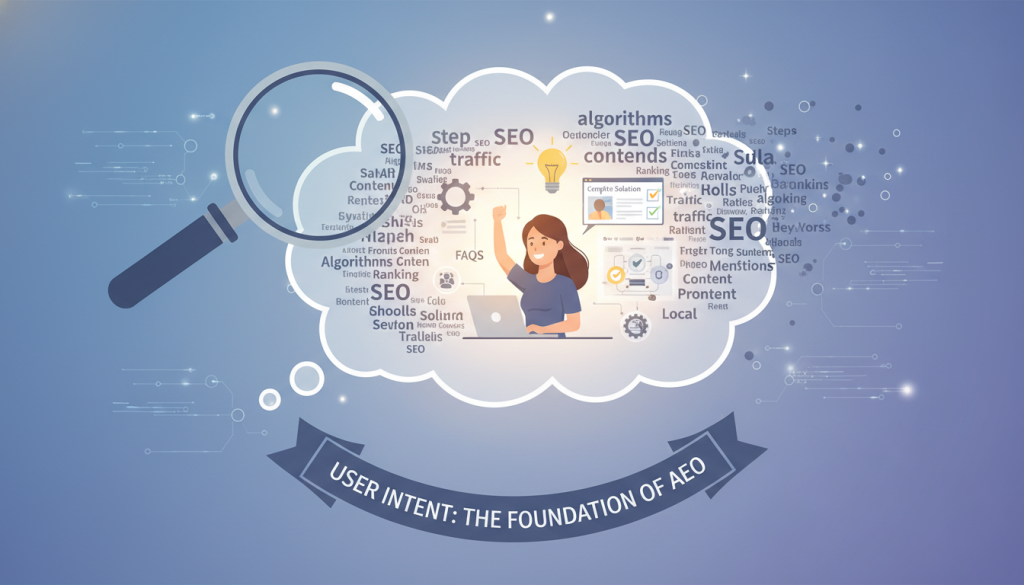
User intent—not keywords—is the foundation of AEO(Answer Engine Optimization). Search engines aim to deliver the most relevant, helpful, and context-aware answers. Content written for algorithms rather than real user needs will fail to earn visibility. Engines reward pages that understand the why behind a query and deliver a complete solution.
What Search Engines Like
Engines prioritize content that solves the user’s actual need:
- Intent-driven answers → Addresses the problem behind the query, not just the language used.
- Contextual relevance → Tailored to the user’s situation (local, informational, transactional, etc.).
- Clear problem-solving structure → Steps, explanations, FAQs, and insights that fully resolve the query.
- Natural language flow → Conversational phrasing ideal for voice and AI search.
- Personalization signals → Adaptation based on location, device, or query type.
The Risk of Ignoring Intent
- Content may rank but fail to convert.
- Engines deprioritize shallow, generic answers.
- Competitors who align better with user intent dominate featured snippets and voice results.
Best Practice
Ask yourself: What is the user really trying to achieve with this query? Then create content that provides a clear, complete, context-aware answer. Use conversational language, structured data, and local relevance to align with intent.
Intent-driven content is the core of AEO(Answer Engine Optimization) success. When your answers match user needs and context, search engines reward you with visibility, credibility, and conversions.
Conclusion AEO (Answer Engine Optimization)
Answer Engine Optimization (AEO) is no longer optional—it’s the future of search visibility. At its core, AEO(Answer Engine Optimization) is built on clarity, context, and credibility. The brands that win tomorrow are the ones that take action today. Treat AEO(Answer Engine Optimization) as a growth engine, not a checklist. Search engines and AI assistants are designed to deliver the most accurate, intent-driven answers, and they reward businesses that create content aligned with these principles of Answer Engine Optimization
Pingback: How AEO Turns Your Website Into a 24/7 Lead Machine | Tamim Hossain Arabi