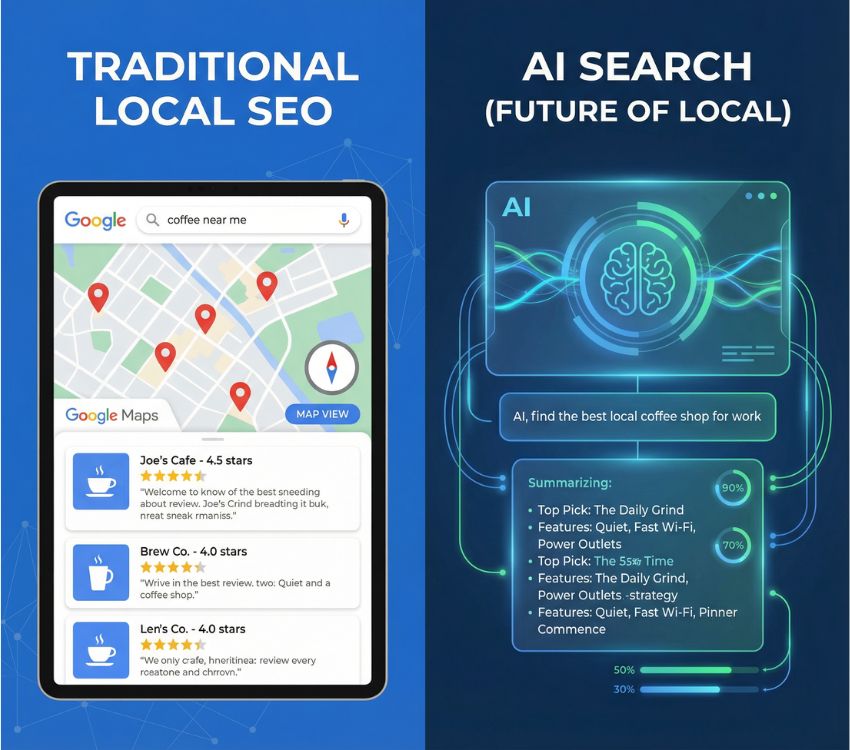

Answer Engine Optimization (AEO) is the practice of making your content the best answer for AI tools like Google AI Overviews, ChatGPT, Perplexity, and voice assistants. Unlike traditional SEO, which focuses on ranking webpages, AEO focuses on ranking direct answers.
Search behavior has shifted. People now ask full questions instead of short keywords, and AI systems scan the web to pick only a few trusted sources. This creates a new competition: not for ten blue links, but for one answer box.
Zero‑click searches are growing fast. Users often get what they need from AI summaries or voice responses without visiting a website. If your content isn’t included in these answers, your visibility drops—even with strong SEO rankings.
AEO matters because being chosen as a trusted source boosts your brand authority, builds trust, and increases conversions. In an AI‑first world, AEO is essential for staying visible, relevant, and competitive.
How Answer Engines Work

Answer engines like Google AI Overviews, ChatGPT, and Perplexity work by scanning the web, understanding questions, and selecting the most reliable answers. Large Language Models read millions of pages and look for clear explanations, accurate facts, and consistent information before combining them into a single helpful response. Structured data, schema markup, and knowledge graphs make this process easier by telling AI exactly what your content contains and how different topics and entities are connected. To choose the “best answer,” AI checks clarity, accuracy, authority, and intent match, favoring sources that provide direct answers, verified facts, and strong trust signals. Because AI extracts information, not long paragraphs, concise, factual, and well‑organized content is far more likely to be selected and quoted in AI‑generated results.
Core AEO Ranking Factors

Clear and direct answers are one of the strongest AEO ranking factors. Answer engines prefer content that is simple, easy to read, and focuses on one idea at a time. When your content is clean, structured, and confident, AI systems can extract it quickly and choose it as the “best answer.”
What makes your content rank better in AEO:
- 40–60 word direct answers: Start each section with a short, complete answer that clearly explains the topic.
- Question-aligned headings (H2/H3): Write headings that match the exact question users search for.
- Single-intent responses: Answer only one question or idea at a time to avoid confusion.
- Scannable formatting: Use bullets, lists, and tables so AI can extract information easily.
- Strong definitions and summaries: Explain concepts in simple words and add confident statements that show clarity and accuracy.
By keeping your content clear, focused, and easy to understand, you significantly increase your chances of being selected by answer engines like Google SGE, ChatGPT, and Perplexity.
Topical Authority & Expertise

Topical Authority & Expertise play a major role in AEO because answer engines prefer sources that show deep knowledge and consistent coverage of a subject. This starts with building deep, interconnected topic clusters that cover every important question your audience may ask. AI tools also look for expert‑level, citable content supported by accurate facts, trusted references, and clear explanations. Strong E‑E‑A‑T signals—experience, expertise, authority, and trust—help AI understand why your content is reliable. Adding author bios, credentials, and proof signals strengthens credibility even more. Finally, smart internal linking connects related pages and reinforces your expertise across the entire topic, making it easier for answer engines to trust and select your content.
Structured Data & Schema Markup

Structured Data helps answer engines clearly understand what your content is about. By adding schema types like FAQ, How‑To, Product, and Review, you give AI a direct map of your page’s key information. Using JSON‑LD makes this data easy for machines to read and process. Adding entity‑rich markup—such as names, places, products, and definitions—helps AI connect your content to known concepts in its knowledge graph. When your schema is accurate and matches your on‑page content, answer engines can quickly identify your information, trust it, and use it when generating answers. This makes schema one of the strongest technical signals for AEO success.
High‑Quality Fact Density

High‑Quality Fact is one of the strongest signals answer engines look for when choosing which content to trust. AI tools prefer pages that include verified statistics, credible quotes, and clear citations, because these elements prove that the information is accurate and well‑researched. Accuracy is now a direct ranking factor for AI systems, and even small errors can reduce your chances of being selected. When your content consistently provides reliable facts, up‑to‑date data, and trustworthy references, you become a reference‑worthy source that answer engines can confidently cite. This not only improves your visibility in AI‑generated answers but also strengthens your overall authority in your niche.
Semantic Relevance & Query Matching

Relevancy focuses on making sure your content truly matches what users are asking. Answer engines prefer pages written in natural language that aligns with user intent, not keyword‑stuffed text. This means your content should clearly answer the main question while also covering related questions and subtopics that users may search next. By using semantic SEO strategies—such as synonyms, contextual phrases, and topic‑based structuring—you help AI understand the full meaning of your content. When your page matches intent, provides context, and connects related ideas, answer engines see it as more complete and are more likely to select it as the best answer.
Content Format Optimization

Welformat Content is essential for helping answer engines understand and extract your information quickly. AI tools prefer pages with a clear H2/H3 structure and short, easy‑to‑read paragraphs because they make the content more organized and predictable. Using bullets, lists, and key takeaways helps break down information into simple pieces that AI can scan and quote. Adding Q&A‑style blocks also improves extraction, because they directly match how users ask questions. When your content is clean, structured, and formatted for quick understanding, answer engines can easily identify your main points and select your page as a reliable source.
Website Credibility & Technical Trust Signals

Trusted signals help answer engines decide whether your site is safe, reliable, and worth showing in AI‑generated answers. A secure site with HTTPS, fast loading speed, and a clean, user‑friendly design sends strong trust signals to both users and AI systems. Your domain reputation and trust score also matter, because AI tools prefer websites with a history of quality content and positive user behavior. Keeping your site free from spam signals, broken elements, and messy code makes it easier for AI to crawl, understand, and trust your pages. When your website is technically strong and credible, answer engines are far more likely to select your content as a dependable source.
Freshness & Update Frequency

Updates are key signals answer engines use to judge whether your content is still useful and trustworthy. AI tools prefer pages that include regular updates with current data, because outdated information can reduce accuracy. Refreshing your content based on seasonal changes, new trends, or industry shifts helps keep it relevant to what users are searching right now. Adding historical updates—such as noting when information was revised—also builds credibility and shows that your content is actively maintained. When your pages stay fresh, accurate, and up to date, answer engines are far more likely to select them as reliable sources.
Backlinks & Brand Mentions
These help answer engines understand how trusted and well‑known your website is across the web. AI systems look at citations from other sites to judge your authority, similar to how academic papers rely on references. While traditional backlinks focus on clickable links, brand mentions—your name appearing on reputable sites even without a link—also strengthen your credibility in AI models. The goal is to build topical link authority, meaning your site is consistently referenced within your niche. When other trusted websites talk about you or cite your content, answer engines see your brand as reliable and are more likely to use your information in AI‑generated answers.
User Engagement & Behavioral Signals
More engagement helps answer engines understand whether people find your content useful. When visitors stay longer on your page and scroll through more sections, it shows strong time on page and scroll depth, which signals that your content is valuable. AI tools also learn from positive feedback loops, such as users clicking your result again or choosing your answer inside AI search tools. Most importantly, content that satisfies the query instantly—by giving clear, direct answers without confusion—keeps users engaged and reduces bounce rates. When your page consistently delivers fast, helpful information, answer engines are more likely to trust it and feature it in AI‑generated results.
How to Optimize Your Content for AEO
You may start with creating direct answer content blocks that give clear, short, and accurate responses to common questions. Adding structured data and schema markup helps answer engines understand your page and extract key information more easily. You should also improve your clarity, E‑E‑A‑T signals, and fact density by using simple language, verified data, expert insights, and trustworthy citations. Strengthening your internal and external linking helps AI see how your content connects to other reliable sources, building stronger topical authority. Finally, using tools that analyze AI ranking performance allows you to track how often your content appears in AI answers and identify areas for improvement. Together, these steps make your content easier for answer engines to trust, understand, and feature.
Common AEO Mistakes to Avoid
One major issue is keyword‑stuffed or over‑optimized content, which makes writing feel unnatural and reduces trust from both users and AI systems. Another common mistake is using outdated or unverified information, which can cause answer engines to ignore your page completely. A weak structure that AI cannot parse—such as long blocks of text, unclear headings, or missing summaries—also makes it harder for AI to extract answers. Finally, many websites lose visibility by ignoring schema or entity optimization, which are essential for helping AI understand your content. Avoiding these mistakes keeps your pages clear, trustworthy, and ready for AI‑first search.
Conclusion:
The Future of AEO AEO is becoming one of the most important strategies in the AI‑first search world, and the brands that adopt it early gain disproportionate visibility. When your content is optimized for direct answers, AI tools are more likely to cite you repeatedly, giving you a strong advantage over competitors who still rely only on traditional SEO. To future‑proof your content, focus on clarity, accuracy, structured data, and strong topical authority so answer engines can easily understand and trust your information. As AI continues to shape how people search, AEO becomes the new competitive edge, helping your brand stay visible, credible, and relevant in a landscape where only a few trusted sources are chosen to represent the best answers.