Search has changed. AI Overviews now dominate results. But abandoning traditional local SEO would be a mistake.
Not long ago, the playbook was simple. Claim your Google Business Profile. Keep your name, address, and phone number consistent. Build citations. Collect reviews. Show up on Maps. Done.
Then AI search arrived. Google’s AI Overviews started pulling information from multiple sources and presenting it as ready-made summaries — no clicking required. Businesses that spent years chasing Page One rankings suddenly found themselves asking the same question: Does traditional local SEO still matter?
It does. But the rules have shifted. Let’s break down what’s changed, what hasn’t, and exactly how to play both sides of the board.
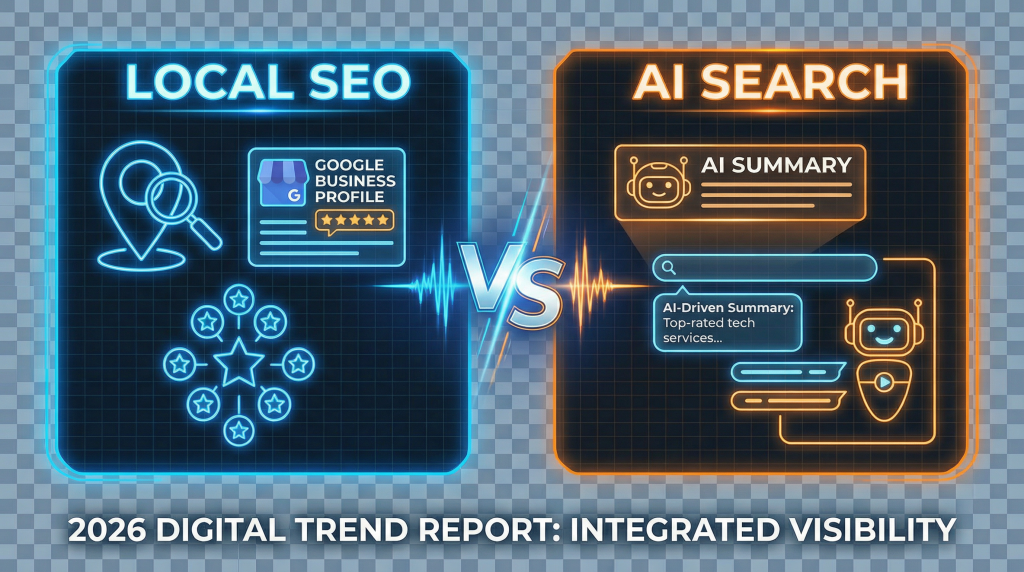
01 What Traditional Local SEO Actually Does
Local SEO is the process of making your business visible when someone nearby searches for what you offer. Its job is simple: connect real people with real businesses in a specific place.
Google Business Profile — Your storefront on Google Maps. It carries your hours, location, photos, and reviews. Without it, local customers can’t find you.
NAP Consistency — Your Name, Address, and Phone number must match exactly across every directory, social profile, and webpage. Inconsistency kills trust.
Local Citations — Mentions of your business on third-party sites confirm your details to Google and build authority.
Customer Reviews — Social proof that influences both rankings and purchasing decisions. Reviews matter more than most businesses realize.
When someone searches “best coffee shop near me” or “dentist open now,” Google uses these local signals to decide what to show. Strong local SEO means your business appears, attracts clicks, and earns real foot traffic.
02 What AI Search Actually Does
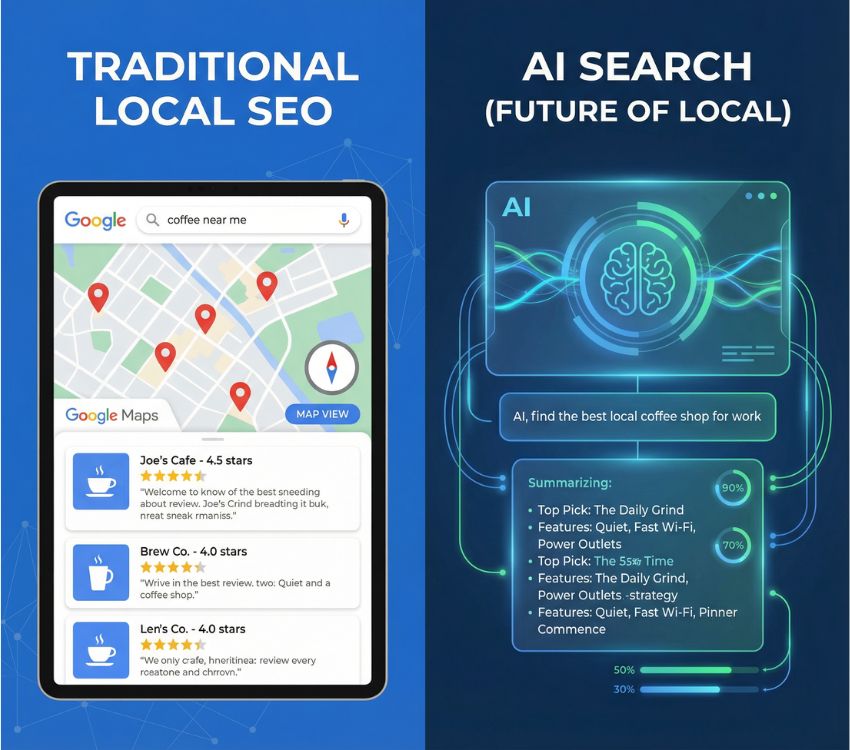
Google’s AI Overviews represent the most visible shift in how search results look. Instead of a ranked list of links, the AI reads content from across the web and generates a direct summary answer at the top of the page.
“The goal is no longer just to rank — it’s to be chosen. Google’s AI decides whose content is worth featuring. That’s a fundamentally different competition.”
This changes the game in two ways. First, users get answers without clicking through. Second, the websites that earn those featured positions aren’t always the ones that rank highest in traditional results. What wins here is clarity, authority, and depth.
Traditional Local SEO
AI Search (Overviews)
GoalRank high in local results & Maps
GoalGet content included in AI summaries
What Google NeedsNAP consistency, citations, reviews
What Google NeedsDetailed, authoritative, trustworthy content
User ActionClicks through to your site or Maps listing
User ActionReads the summary — may or may not click
Content TypeBusiness details, structured data
Content TypeLong-form guides, multimedia, FAQs
03 Why You Can’t Drop Local SEO
Here’s the critical point most people miss: AI search doesn’t replace local SEO. It builds on top of it.
Google’s AI still needs signals. It still needs your business profile. It still checks your reviews. It still looks at your citations to confirm you exist and that your details are accurate. A weak local SEO foundation means AI search won’t feature you — full stop.
The Real Story: AI Search Needs Local SEO to Work
Local intent hasn’t gone anywhere. People still search “best pizza near me” and “dentist open Sunday.” Voice search, mobile search, and Maps all run on the same local signals they always have. AI Overviews are an add-on — not a replacement for the infrastructure beneath them.
Most local searches happen on phones. Voice assistants depend entirely on accurate, structured local data. If your NAP details are inconsistent or your Google Business Profile is incomplete, you lose — in both traditional and AI search.
04 How to Adapt Your Local SEO for AI
The smart move isn’t to choose between traditional SEO and AI-readiness. It’s to evolve your existing strategy so it performs in both environments.
Four Adjustments That Move the Needle
- Write long-form, authoritative content. In-depth guides and detailed service pages are the content Google’s AI prefers. Answer questions fully. Show expertise.
- Add multimedia. Images, videos, and infographics — properly optimized with alt text and transcripts — signal quality to both users and AI.
- Use structured data (schema markup). Schema tells Google exactly what your business offers. It improves visibility in both traditional local results and AI-driven features.
- Keep local content fresh. Regularly update city pages, service descriptions, and blog content. Active, accurate content signals that your business is alive and trustworthy.
None of this is radical. It’s an upgrade, not a rebuild. The businesses that combine a tight local SEO foundation with AI-friendly content will appear twice: in Maps and listings AND in AI summaries. That’s double the visibility against competitors who only do one or the other.
05 What the Future Actually Looks Like
AI search will keep evolving. But the fundamentals it relies on — accurate business information, genuine customer reviews, trusted local signals — are not going anywhere.
The businesses that will win are the ones that treat AI readiness as an extension of good local SEO, not a replacement. They’ll maintain strong profiles and citations while also producing content that earns Google’s AI the confidence to feature them in summaries.
The rest will wonder why their visibility is fading.
The Answer Is Both. Always Both.
Audit your Google Business Profile. Lock down your citations. Update your content. Build for AI visibility without abandoning the local SEO basics that got you here. That’s the move.Start Your Local SEO Audit